📊
AI Visibility Tracking
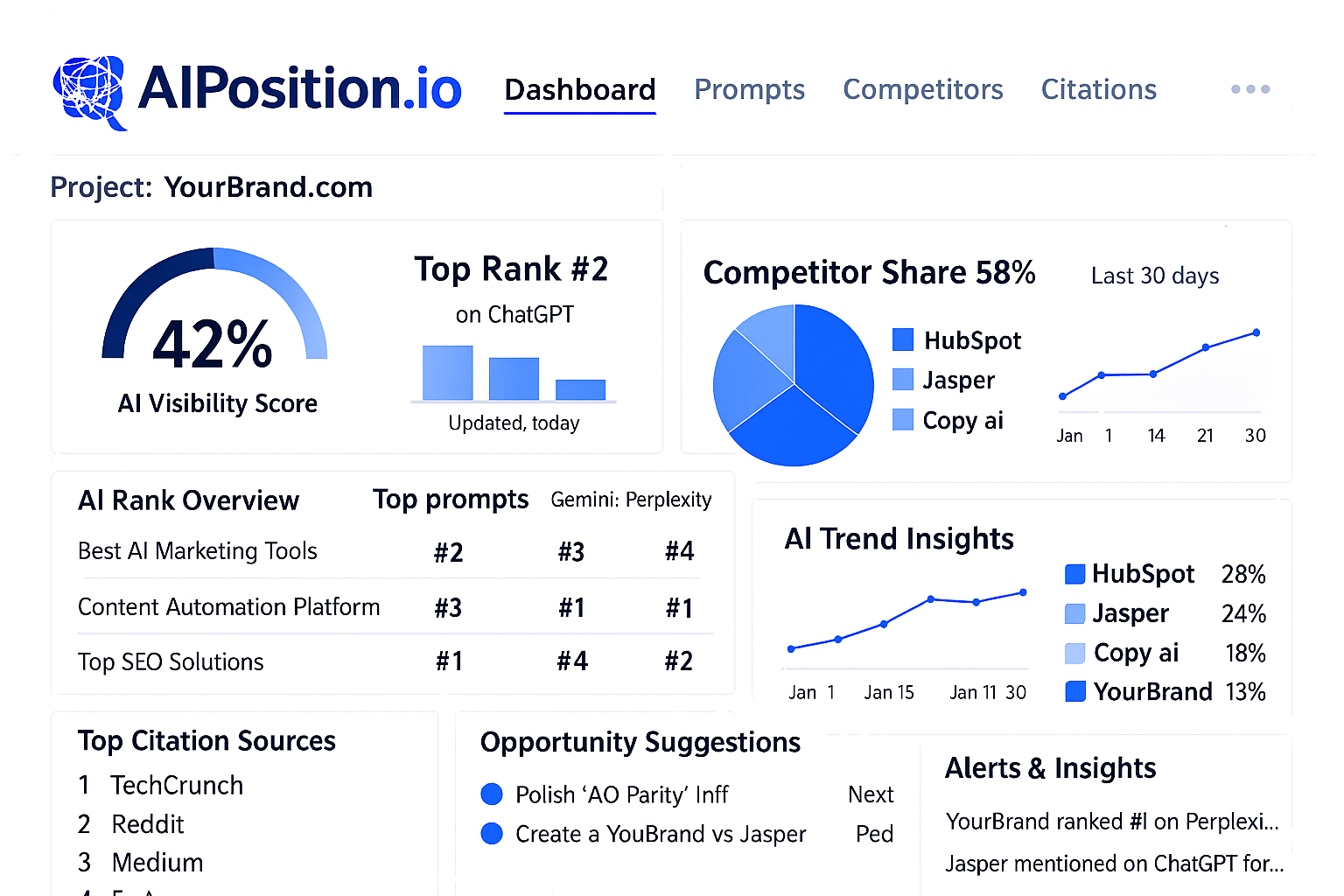
We run real prompts against ChatGPT, Gemini, Claude, and Perplexity and record whether your brand gets named, cited, or recommended. You get a clear citation rate — and you can watch it move as you make changes.
AI SEO Optimization
Ranking on Google is no longer enough. Your customers are asking ChatGPT what tool to use, asking Gemini which brand to trust, and getting answers that never mention you. AIPosition tracks where you stand across all four major AI platforms — and tells you exactly what to fix.
No credit card • 7‑day AI SEO audit • Cancel anytime
Answer Share
Organic Sessions
Entity Coverage
Time to Publish
Search didn't die — it split in two. There's the Google results page you've been optimizing for since 2010, and then there's the AI answer layer that's eating it from the top. Researchers at Princeton and Georgia Tech found that brands using proper AI SEO strategies got cited up to 40% more often in AI responses. Meanwhile, visitors coming from AI tools convert at 23× the rate of organic search visitors. This isn't a trend worth watching. It's already happening to your pipeline.
Here's what nobody tells you: you can rank #1 on Google and still lose the customer. If someone asks ChatGPT "what's the best tool for X" and you're not in the answer, that click never happens. AI Overviews have already cut organic CTR by 61% for affected queries. In Google's AI Mode, 93% of searches end without a single click to any website.
The brands winning right now figured out that SEO and AI visibility aren't separate strategies — they're the same bet, just measured differently. AIPosition gives you both views in one place.
Think of it as two layers of the same game. The first layer is classic SEO — rankings, crawlability, site speed. The second layer is making sure that once AI systems find your page, they actually trust it enough to quote it. AI SEO is the practice of doing both at once: getting into search indexes and getting picked as the source when someone asks a question that's relevant to your business.
| Dimension | Traditional SEO | AI SEO |
|---|---|---|
| Goal | Rank in search results | Get cited in AI-generated answers |
| Success metric | Rankings, traffic, CTR | Citation frequency, mention rate, AI referrals |
| Focus unit | Page-level: titles, keywords, backlinks | Fact-level: citable statements, entities, structured sections |
| Content approach | Keyword-optimized pages | Answer-first sections, FAQ blocks, self-contained paragraphs |
| Technical layer | Speed, mobile, crawlability | + Schema markup, AI crawler access, Bing indexation |
| Top authority signal | Backlinks (correlation: 0.218) | Branded web mentions (correlation: 0.664) |
| Replaces the other? | No — AI SEO requires SEO as its foundation. "SEO feeds AI." | |
AI systems don't just match keywords — they look for brands they can confidently name. If your content isn't mapped to clear entities and relationships, you're a blur in the knowledge graph. Entity-first content fixes that.
96% of what AI cites comes from third-party sources, not your own site. Citation readiness means making it easy for AI to trust you — through structured data, original research, and external mentions that build that credibility signal.
You don't have to choose between ranking on Google and getting cited by ChatGPT. The same technical health, clear writing, and authority signals that help one also help the other. That's the whole point of this approach.
Most people optimizing for AI visibility are guessing. But there's real research on exactly how this works. AI assistants use a process called Retrieval-Augmented Generation — RAG — and once you understand the three stages, the optimization decisions become pretty obvious.
When someone asks ChatGPT a question, it doesn't dig through its training data. It runs a search — on Bing. If your site isn't indexed there, or your page doesn't match what the query is actually asking, you never even get considered. This is why traditional SEO still matters enormously. Without it, the AI can't find you at stage one.
Found pages are broken into chunks, usually 200–500 words each, and turned into semantic vectors. The AI then scores those chunks against the original question. A paragraph that only makes sense in context of the paragraph before it? Terrible vector. A paragraph that opens with a direct, standalone answer? That's what gets pulled. This is the "Island Test" — write every section so it can stand alone.
The best-scoring chunks get woven into the AI's response, with sources attached. What determines "best"? Content freshness. Schema markup. Clear structure. And increasingly — how many other credible places on the web mention your brand. Backlinks have a 0.218 correlation with AI citation. Branded web mentions have a 0.664 correlation (Position Digital, 2026). That gap is telling you exactly where to put your energy.
Read any paragraph on your site in isolation. Does it make sense? Does it answer something on its own? If the answer is "no, you'd need to read the paragraph before it" — that's a paragraph that AI systems will skip over. Rewrite it to open with a complete thought, then add context after.
Not all AI platforms work the same way — and being cited on one doesn't guarantee you appear on another. ChatGPT searches Bing. Gemini uses Google's index. Perplexity pulls from different sources entirely. AIPosition tracks your brand across all of them, separately.
Still the dominant player by a wide margin. Uses Bing's web index — so if you've never set up Bing Webmaster Tools, ChatGPT is essentially blind to you. AI referral traffic from ChatGPT grew 123% in just six months. It's the one to get right first.
Gemini has nearly quadrupled its market share in a year. AI Overviews now appear in 30%+ of US searches, and in AI Mode, 93% of sessions end without a click. If you're not being cited here, your Google rankings are protecting less than you think.
Smaller audience, but a much higher click-through rate to cited sources compared to ChatGPT. If your goal is actual referral traffic from AI — not just a mention — Perplexity is the platform to focus on. It also skews heavily toward recency, so fresh content matters here.
These are the enterprise platforms. Copilot is embedded in Microsoft 365 — meaning it's answering questions inside tools your B2B buyers use all day. Claude grew 12.8× last year. These aren't niche platforms anymore.
Most marketing teams have no idea whether ChatGPT mentions their brand. AIPosition changes that — and then tells you what to do about it.
We run real prompts against ChatGPT, Gemini, Claude, and Perplexity and record whether your brand gets named, cited, or recommended. You get a clear citation rate — and you can watch it move as you make changes.
There are queries where your competitors get recommended and you don't. We surface those exact prompts. You can't find these in Ahrefs or Google Search Console — they only show up when you actually ask the AI.
See exactly who's getting cited instead of you and why. We track which external sources are driving competitor mentions — so you know whether to target G2, Reddit, industry roundups, or something else entirely.
We track which of your pages and assets are actually getting cited, which external sources are validating your brand to AI systems, and where the gaps in your citation footprint are. It's a different picture than backlinks tell you.
If AI systems can't clearly identify what your brand does or who it serves, they won't confidently recommend it. We help you close those knowledge graph gaps — schema markup, entity disambiguation, structured data that actually gets read.
Not everything is worth doing in week one. We prioritize actions by how much impact they're likely to have — so you're fixing the robots.txt issue before you're rewriting a blog post that doesn't rank anyway.
We've kept this deliberately simple. Four steps, and each one feeds the next.
Before you fix anything, you need to know where you actually stand. We track your current citation rate across all four platforms and set a real baseline — not a guess.
We match your content to the questions your buyers are actually asking AI — and find the entity and schema gaps that are making you invisible even when your pages rank.
Every new or updated piece of content follows the Island Test — each section opens with a direct answer that AI can pull without the surrounding context. That's what gets cited.
We track citation rate, AI referral traffic, sentiment, and organic KPIs together. Target 30%+ citation rate — the top brands in most categories are already above 50%.
Some query types are worth a lot more than others. Here's where to start.
When someone asks "what's the best AI SEO tool" or "best CRM for a small team," they're about to make a buying decision. These are the highest-intent queries in AI — and your competitors are optimizing for them right now whether or not you are.
"X vs Y" and "alternatives to X" queries are gold in AI search. AI systems lean toward brands that give clear, honest comparisons — not the ones that write promotional copy about themselves. If you own these queries, you own a chunk of your competitor's evaluation stage.
NerdWallet's revenue went up 35% while their traffic went down 20%. How? Their content was influencing financial decisions inside AI answers before anyone clicked anywhere. That's what being cited at the product-consideration stage is worth.
Less traffic, more revenue. NerdWallet grew 35% on the back of AI citations while organic traffic fell 20%. Their financial guides were being read by AI systems and surfaced to users at the exact moment they were deciding. It's a preview of how B2B buying decisions will work in 2026 and beyond.
Run a free 7-day audit. We'll show you your current citation rate across ChatGPT, Gemini, Claude, and Perplexity — and give you a prioritized list of what to fix first.
Create Free AccountNo credit card · 7-day AI SEO audit · Cancel anytime