
Prompt Coverage
Track inclusion across “best for…”, “X vs Y”, and solution prompts.
- Coverage by topic & intent
- Competitor overlap & gaps
- Trend alerts
New • ChatGPT Tracking
See every mention, prompt, and citation powering AI answers. Fix entity gaps, strengthen sources, and boost your share of recommendation.
No credit card • Includes competitor snapshot • 7‑day audit
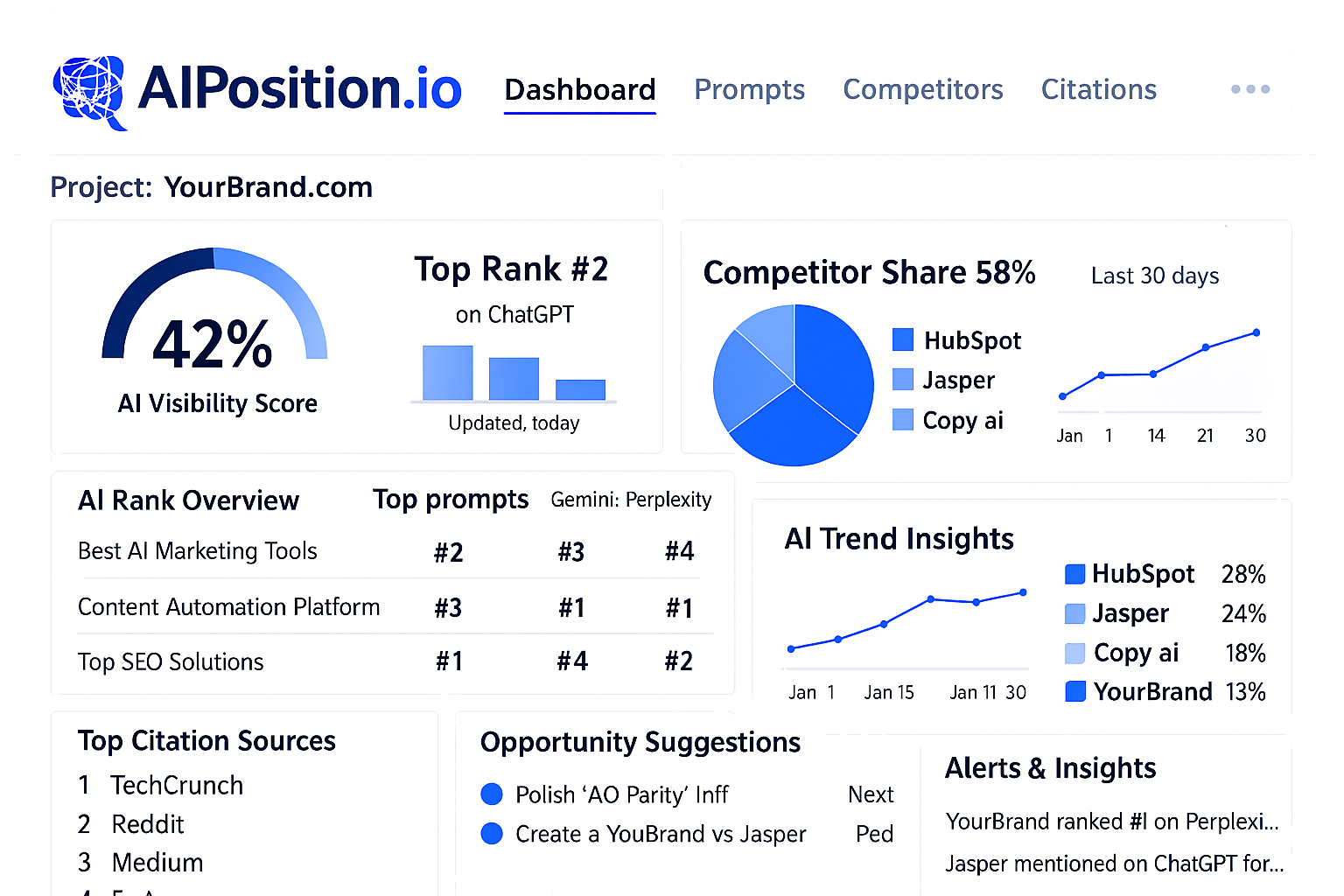
Share of Rec
Citations Found
Time to Insight
Entity Coverage
ChatGPT now has 900M+ weekly users and handles 5.5 billion site visits per month (Exploding Topics, 2026). 77% of US users treat it as a search engine. But none of that traffic shows up in Google Search Console, Google Analytics, or any SEO tool you already use. If your brand isn't being tracked inside ChatGPT, you have a blind spot in your most important and fastest-growing discovery channel.
Pinpoint the prompts, sources, and entities that decide whether you’re recommended—or ignored.
Track inclusion across “best for…”, “X vs Y”, and solution prompts.
See which references fuel ChatGPT’s answers and which you’re missing.
Quantify how often you’re named vs. competitors across prompts.
Cycle through examples to see how prompts map to inclusion and citations.
High-intent category prompts with the strongest recommendation impact.
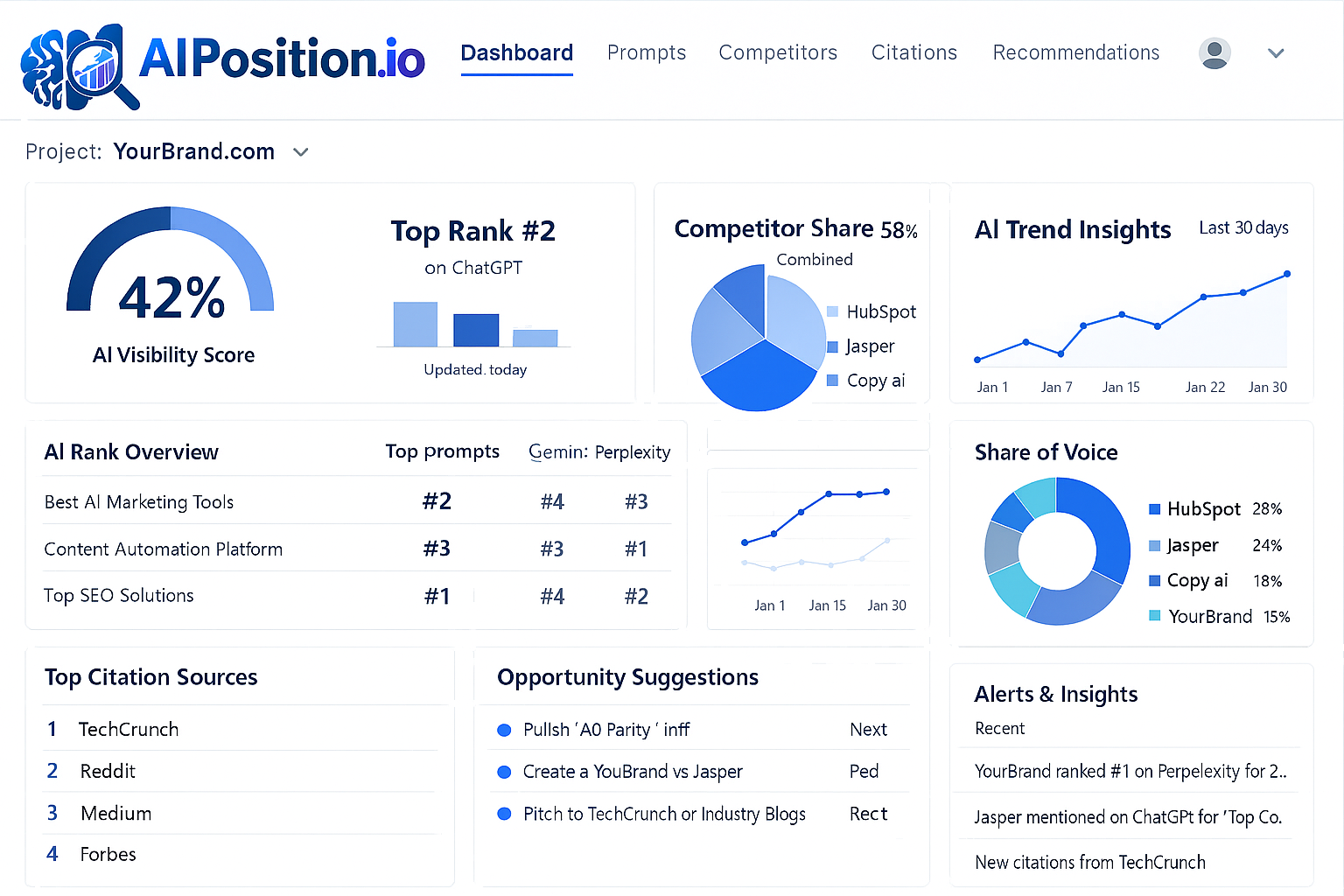
Comparison prompts that shape vendor shortlists.
Displacement prompts—critical to monitor and counter.
Traditional SEO platforms like Ahrefs, Semrush, and Google Search Console were built to track one thing: your position in Google's ranked list of blue links. ChatGPT doesn't produce a ranked list. It generates a single synthesised answer, and whether your brand appears in that answer is completely invisible to every tool you're already using.
A customer asks ChatGPT "what's the best CRM for a 10-person sales team?" — your brand gets recommended, they visit your site, and sign up for a trial. In Google Analytics, that session is labelled "direct" or "referral from chatgpt.com" with no context. Without dedicated ChatGPT tracking, you have no idea which prompt triggered the visit, whether you were recommended or merely mentioned, or whether a competitor was named first.
| What you want to know | Traditional SEO tools | AIPosition ChatGPT Tracking |
|---|---|---|
| Is my brand mentioned in ChatGPT answers? | ❌ Not tracked | ✅ Tracked across 100s of prompts |
| Which prompts trigger my brand? | ❌ Not visible | ✅ Full prompt-level breakdown |
| Which competitors get named instead of me? | ❌ Not visible | ✅ Competitor share of voice tracked |
| Which sources does ChatGPT cite about my brand? | ❌ Not visible | ✅ Citation source mapping + scoring |
| Is ChatGPT's description of my brand accurate? | ❌ Not visible | ✅ Accuracy and sentiment monitoring |
| How do I improve my ChatGPT mention rate? | ❌ No guidance | ✅ Prioritised fix recommendations |
A 2025 SurferSEO study found only 24% overlap between ChatGPT API responses and the actual consumer-facing web interface across 1,000 prompts. AIPosition tracks the real ChatGPT experience your customers have — not an approximation.
Most people think ChatGPT just "knows" which brands to recommend from training. It doesn't — at least not for current product questions. When someone asks ChatGPT what tool to use, it runs a Bing search, retrieves recent pages, and synthesises an answer from what it finds. Knowing exactly what it looks for at each step is what makes the improvement work obvious.
Your homepage says you're great. ChatGPT doesn't trust your homepage. It trusts what G2, Reddit, industry blogs, and journalists say about you — because those are independent signals. The brands that show up most in ChatGPT answers aren't necessarily the biggest; they're the ones with the widest third-party footprint. Getting into more places than your own site is the core of the work.
ChatGPT's web search runs on Bing's index — not Google's. Which means if you've never set up Bing Webmaster Tools or submitted your sitemap to Bing, ChatGPT literally cannot find your pages when someone asks a relevant question. It takes about 15 minutes to fix and most brands haven't done it. That's the kind of gap AIPosition surfaces on day one.
ChatGPT breaks your pages into chunks and scores each one against the query. A paragraph that depends on the one before it to make sense? Useless to ChatGPT — it scores low and gets dropped. A paragraph that opens with a direct, self-contained answer? That's what gets pulled into responses. If your site is full of marketing prose that builds slowly to a point, you're writing for humans but losing to AI.
AI-cited content is 25.7% fresher than average (Ahrefs, 17M citations). That's not a small gap. If your best guide hasn't been touched since 2023, a competitor who updated theirs last quarter is getting the citation instead of you — even if your original version was more thorough. Freshness isn't a nice-to-have in this channel. It's a ranking signal.
Schema markup tells AI systems what your brand actually is — not what they can infer from your prose. Without it, ChatGPT might know your name but get your category wrong, describe you vaguely, or conflate you with a similarly-named company. It's also one of the reasons brands show up with outdated descriptions even after they've updated their site. Schema is the fix.
Getting mentioned in ChatGPT isn't always a win. "You could try Brand X, but be aware it has a steep learning curve" is a mention. So is "most reviewers prefer Brand Y over Brand X for this use case." AIPosition distinguishes between being the primary recommendation, a secondary option, and an also-ran — because those three outcomes have very different implications for your pipeline.
The underlying pattern is the same regardless of your category. See where you stand, figure out what's holding you back, fix it, and measure whether it moved. The trick is that each cycle makes the next one easier — AI models tend to keep citing sources they've already cited.
We run your target prompts across ChatGPT and map every mention, citation, competitor appearance, and sentiment signal. This is your baseline — the honest picture of where you stand before you change anything.
We flag the specific gaps: prompts where you're invisible, sources ChatGPT is trusting that don't mention you, descriptions of your brand that are wrong or outdated. Most teams are surprised by how different this is from their Google performance.
We give you a prioritised fix list. Some things take an afternoon — submitting to Bing, adding schema, unblocking a crawler. Others take longer — earning a G2 review, getting into an industry roundup. We tell you which to do first.
We re-run the same prompt set after changes and show you the delta. Citation rate up? Which prompts moved? Which competitors lost ground? This is the feedback loop that turns a one-time audit into a compounding advantage.
Connect GA4 and Search Console to see ChatGPT citations alongside your organic traffic in one view. Export to Sheets or CSV for reporting, and push actionable tasks straight to Slack or Notion so fixes don't get lost in a dashboard nobody revisits.
Run a free 7-day audit and we'll show you your current ChatGPT citation rate, which prompts your competitors are winning, and a prioritised list of what to fix first. Most teams find something actionable in the first 24 hours.
Create Free AccountUpgrade anytime • Annual billing saves 20%